 Reviews


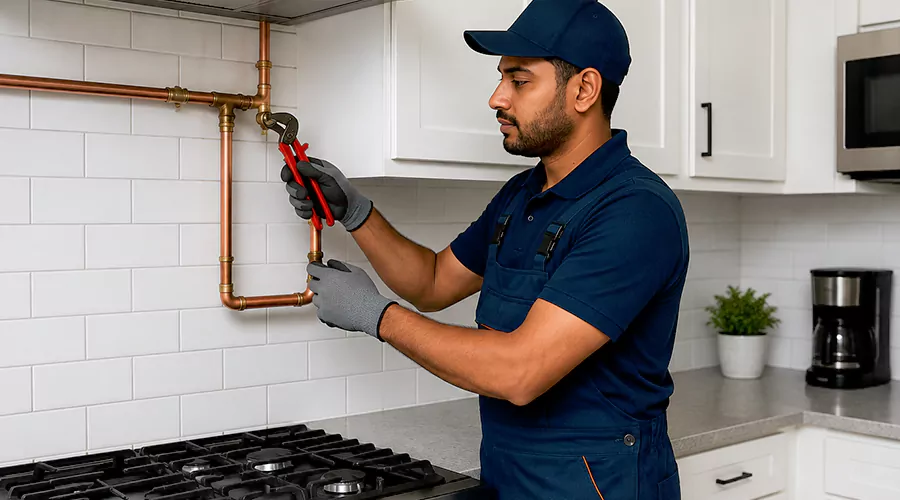
Installing a gas pipe in a kitchen is licensed work in most places, and most US jurisdictions require a licensed plumber or gasfitter plus a permit pulled through the building department. The professional job averages $1,027 in 2026 with most projects landing between $600 and $2,200.
This guide explains the full process so you can plan it and price it and inspect the quotes. It also covers the one connection homeowners can legally make in many US areas.
Gas rewards knowledge and punishes shortcuts. Read the legal section before anything else.
The Legal Line Comes First
Licensing rules decide who holds the wrench before any material gets chosen. Kitchen gas pipe installation in house projects requires a permit almost everywhere in the US, and jurisdictions like Houston require a plumbing permit plus at least one pressure test inspection on every new line. Unpermitted gas work also voids insurance claims when anything goes wrong.
Other countries draw the line even harder. The UK restricts gas hob pipework and every other gas connection to Gas Safe registered engineers by law, and Australia and much of Europe run equivalent schemes. Readers in those regions should treat this article as purely educational.
The US carve-out stays narrow. Many American jurisdictions allow homeowners to connect an appliance to an existing valve with an approved flexible connector, while new pipe runs remain licensed territory nearly everywhere.
Insider tip: Call your building department before calling any contractor. The permit clerk tells you in five minutes what's legal for you specifically at your address.
Materials Used in Kitchen Gas Runs
Three materials carry nearly all residential gas in 2026. Gas pipe fitting in kitchen runs uses threaded black iron or flexible CSST with copper permitted only regionally. Each has a clear role.
- Black iron pipe: The traditional threaded steel costs $2 to $4 per linear foot and wins on short straight interior runs.
- CSST: The yellow corrugated stainless tubing costs $8 to $15 per foot and installs 3 to 5 times faster through existing walls and joist bays. Its flexibility also handles seismic movement better than rigid pipe.
- Copper: Used in some regions but not permitted everywhere for gas.
- Polyethylene: Outdoor buried runs only with tracer wire and transition fittings at each end.
Sealing is its own specification. Every kitchen gas pipe fitting seals with gas-rated pipe dope or yellow gas-rated tape rather than the white plumbing tape sold beside it.
Planning the Run and Sizing the Pipe
Planning decides safety before the first thread cuts. Adding a gas line to kitchen spaces starts with a BTU load calculation across every appliance the line will feed. An undersized supply starves every appliance so the stove flame yellows and the water heater short-cycles.
Routing follows the load math. A gas pipeline for kitchen service tees off the main supply near the meter and travels the shortest protected path to the range location. Two hardware rules ride along since a shutoff valve installs at the connection point behind or beside the stove and code puts the valve for any gas line in kitchen installs within easy reach of the appliance.
Budget scales with distance. Extending gas line to kitchen locations from existing supply runs $284 to $1,319 while brand-new service from the meter costs more.
Insider tip: Put the future in the load calculation. Sizing the line for a possible outdoor grill or garage heater now costs almost nothing against re-piping later.
How Pros Run the Line Step by Step?
Understanding the professional sequence makes every quote readable. Running gas line to kitchen stove locations follows six stages from shutdown to signoff. Most residential installations finish in one to two days.
- Gas off and lines purged: The meter valve closes and appliances vent before any pipe opens.
- The tee and the route: The new branch joins the main at a fitting sized to the load calculation.
- Pipe assembly: Black iron threads together with dope on every joint while CSST runs continuously with terminating fittings. Gas pipe installation in kitchen walls includes protective nail plates wherever pipe crosses studs.
- The drip leg: A short vertical stub near the appliance catches moisture and debris before the valve.
- The shutoff valve: Installed at the appliance location with handle access.
- Support and bonding: Pipe strapped at code intervals with CSST electrically bonded to the grounding system.
Full installing gas line for kitchen stove projects end at inspection rather than at the last fitting, and inspectors check every gas pipe line fitting in kitchen work before walls close.
Pressure Testing and Inspection
The pressure test is the moment the system proves itself. The installer caps the new line and pressurizes it with air well above operating pressure, then watches a gauge for a code-specified hold time. A needle that drops means a leak somewhere and the test repeats after the fix.
Paperwork completes the safety loop. Kitchen gas line installation ends with the city inspector verifying the test and the workmanship against code before signoff. The plumber checks burner flames for steady blue combustion once gas flows.
Never let anyone skip this stage. A contractor who waves off the pressure test is volunteering your family for the leak detection role.
Insider tip: Ask for a photo of the gauge at test pressure with a timestamp. Good installers take one for their own records anyway.
Connecting the Appliance
The appliance connector is the one link homeowners handle legally in many US areas. A gas cooker connection pipe is the flexible corrugated line between the shutoff valve and the range. Flexible connectors allow minor movement without stressing the line.
The rules are short and absolute. Use a new connector rated for the appliance and never reuse an old one. The gas fitting for cooker hookups threads onto the valve and the appliance inlet with two wrenches working against each other. Test the finished joint with soapy water since bubbles mean tighten and retest.
Regional law splits this exact step. Connecting gas hob to gas pipe hardware yourself is legal in much of the US, while a gas hob pipe connection in the UK belongs to a Gas Safe engineer with no homeowner exception. Everything upstream stays professional either way because full cooker gas pipe installation beyond the connector means new pipe and permits.
Insider tip: Hand-loosen the range's shipping fittings before connecting anything. Factory-tight caps mimic cross-threading and cause the most common first-timer panic.
LPG Kitchens Differ
Propane and bottled gas change three things about the same project. Kitchen lpg gas pipeline installation adds a regulator chain and outdoor cylinder rules and a heavier-than-air gas that behaves differently in a leak.
The regulator chain matters most. LPG arrives at tank pressure far above appliance pressure, so a two-stage regulator setup steps it down before the kitchen line. Cylinders and tanks live outdoors with ventilation by code in nearly every jurisdiction.
The physics changes the safety picture. Propane sinks while natural gas rises, which means LPG leaks pool at floor level and in low cabinets. Leak checks on LPG systems start low rather than high.
What Installation Costs in 2026?
Kitchen gas pipe installation pricing runs on distance and access and paperwork. Labor and permits outweigh the pipe itself on most jobs. The table maps the 2026 landscape.
| Scenario | 2026 cost |
|---|---|
| Short accessible run to a stove | About $360 |
| Mid-length run with valve and inspection | About $750 |
| Typical full project range | $615 to $2,248 averaging $1,032 |
| Complete kitchen extension | $800 to $2,500 including inspection fees |
| Permits alone | $100 to $700 by jurisdiction |
Labor drives the meter. Licensed plumbers charge $75 to $150 per hour and labor typically accounts for 40 to 60% of the total. Material choice moves the bill less than expected since the material delta on a typical 30-foot run stays under 20% of the total.
Leak Signs Every Kitchen Owner Should Know
Gas announces its escapes and everyone in the house should know the signals. Utilities add the rotten-egg odorant precisely so noses become detectors. Five signs cover nearly every leak.
- A sulfur or rotten-egg smell anywhere near the kitchen.
- Hissing near the pipe or the connector.
- A stove flame burning yellow or orange instead of blue.
- Dead or dying houseplants near the gas run.
- Unexplained headaches or dizziness that ease outside.
The response never varies. Leave without flipping switches or creating sparks, then call the gas utility's emergency line from outside. Utilities respond to leak calls free at every hour, and embarrassment over a false alarm has never once been the wrong price.
Conclusion
Gas pipe in a kitchen is a licensed and permitted project nearly everywhere with one homeowner-legal connector at the very end. The pressure test and inspection are the safety system rather than red tape. LPG and UK readers face stricter rules still. This week locate your kitchen's gas shutoff valve and teach everyone in the house the leak drill. Those two free steps matter more than any pipe specification in this article.
FAQs
Can I run my own gas line if I pull the permit?
A few US jurisdictions allow owner-occupant gas work with inspection. Most don't so the permit office answer is the only one that counts.
How long does a kitchen gas project take?
One to two days for most residential installations plus the inspection scheduling window.
Is CSST safe near electrical storms?
Modern CSST requires bonding to the grounding system exactly for lightning protection. Bonding is an inspection item.
What size pipe does a typical range need?
Half-inch or three-quarter supply handles most ranges depending on BTU rating and run length. The load calculation decides.
Do gas connectors expire?
They age with the appliance. Replace the connector every time the appliance changes and never pass one between stoves.
Does adding a gas line raise home value?
Gas service to a kitchen is generally viewed as a desirable feature by buyers, especially where cooking culture favors flame.